Precision Pallet, LLC Employee Handbook
Pallet Builder
Welcome to your first day at Precision Pallet. LLC. In this packet you will find a brief overview of responsibilities associated with your new position. You will also be walked through a safety training program that was designed for your specific roll. The purpose of this training period is to ensure that you are familiar with all of Precision Pallet, LLC’s worker and safety policies. At Precision Pallet we are dedicated to the safety and wellbeing of our employees as well as the quality of our product and efficiency of production.
Safety First
At Precision Pallet we strive to put the safety of ourselves and our co-workers first. There are no excuses when it comes to practicing safe working procedures. While working at Precision Pallet you will be exposed to many different types of machinery and will use a verity of pneumatic and handheld tools, all of which present their own safety risks. However, with proper training and the correct use of personal protective equipment (PPE) we can greatly reduce the risk serious injury and prevent potential fatalities. It’s our goal to ensure that everyone makes it home safely at the end of the day.
What is PPE?
PPE or Person Protective Equipment are equipment provided by the company to ensure the safety of our employees. You may purchase your own PPE if you prefer, however, it must be approved by the company’s Safety Coordinator prior to use on the production floor. Below is a list of PPE that will be required for your new position.
- OSHA approved safety glasses.
- OSHA approved hearing protection.
- Work gloves.
The above PPE must always be worn while at your designated work area. To ensure you are practicing safe working habits you will be expected to obey all of Precision Pallet’s safety policies. We will cover the major highlights of the safety policy in this training orientation, but it is highly recommended that you read through the safety policy for yourself. A copy of the safety policy will be provided during the onboarding process.
Safety Glasses
According to a study done by Safety + Health Magazine nearly 750,000 work related eye injuries were reported in 2017. Over 40% of those injuries took place in a manufacturing environment. 90% of those injuries could have been prevented with the proper use of approved protective eyewear. * That’s why we provide safety glasses to our employees and make them mandatory throughout most of the plant. Below are the mandatory guidelines for when safety glasses MUST be worn.
- In your designated workspace and/or within 10 feet of all other active workstations.
- Anytime you are using a pneumatic tool such as nail guns, staple guns, impact drivers, air compressors, etc. If an air hose connects to it, you MUST have your safety glasses on.
- While using any blunt force tool such as hammers and prybars.
- If you are using any handheld power tools such as grinders, Sawzall’s, circular saws, etc.
- Any machine or tool that has a blade.
A good rule of thumb is to simply wear your safety glasses anytime you are on the production floor. Dust and other floating debris can be a hazard anywhere throughout the plant. If you have a question about whether you should have your glasses on to perform a certain task, chances are you should. Do the smart thing and put them on.
If you have further question you can ask your supervisor, the company’s Safety Coordinator, or refer to the company’s safety policy.
Hearing Protection
Did you know that approximately 18% of all manufacturing workers have hearing difficulty? According to the National Institute for Occupational Safety and Health “24% of noise-exposed Manufacturing workers report NOT wearing hearing protection.”* That’s the number one reason for hearing loss in manufacturing worldwide. Most hearing related issues can be prevented by the proper use of approved hearing protection. That’s why we provide approved hearing protection to our employees and make the wearing of hearing protection mandatory in all production environment. Below are the mandatory guidelines for hearing protection:
- Hearing protection MUST always be worn while on the production floor during production hours.
- Anytime you are using any power or pneumatic tools outside of the production fool, but still on company property.
- If you are using your own hearing protection it MUST be approved by the company’s Safety Coordinator prior to use.
- Under no circumstances should headphones, AirPods, or earbuds be used as hearing protection. There are approved noise canceling headphones that can be purchased, but they MUST be approved by the company’s Safety Coordinator prior to use.
Hearing damage is caused by high frequency short wavelength ambiance noise and vibrations produced by most machinery, saws, heavy equipment, and pneumatic tools. Listening to music through earbuds adds to the ambiance noise already present in the manufacturing work environment. This leads to even faster degeneration of hearing then if no hearing protection was being worn. Be smart and protect your hearing.
Work Gloves
One of the greatest risks of infection from workplace injuries comes from puncture wounds and scrapes. Injuries that seem very insignificant, such as splinters, can become serious very quickly if infection sets in. The best way to treat a puncture wound is to prevent it from happening altogether. That’s why the company provides work gloves to all employees working in the production environment.
It’s important to wear work gloves at your workstation and anytime you are handling pallets or raw pallet materials. It’s not uncommon for exposed nail heads to be sticking out of freshly built pallets which can cause a hazard if handled without gloves. Though nails can still pierce through work gloves, they still provide an extra layer of protection. It’s also not uncommon to encounter broken or jagged boards, which pose a risk of abrasions and/or splinters. It’s important to be aware of what pallets and pallet building materials you are handling prior to grabbing ahold of or placing weight on them.
In situations where pallet building materials have been chemical treated or are wet from rain glove liners can be worn to prevent exposure to chemicals.
Working around Forklifts
Precision Pallet has a very high amount of fast paced forklift traffic so it’s important to always be aware of your surroundings. Forklifts are used to move stacks of pallets around the plant and to distribute pallet building materials to designated workstations as needed. This means forklifts will be in and out of your workspace periodically throughout the workday. This proximity with forklift operations opens the door for potential risks in the workplace. Below are some guidelines you should follow to help prevent accidents while working around forklifts.
- If you hear a forklift enter the production floor, take not of which door it enters in and which direction they are going.
- If you are expecting a delivery of pallet building materials or a pickup of a completed stack of pallets be prepared to move.
- Make sure you are aware of you air gun hose so if you must move out of the way it doesn’t become a trip hazard.
- Always have an escape plan ready encase of an emergency. You should be able to get out of the way without any obstructions.
- Make eye contact with the forklift driver every time they enter your workspace.
- If you feel uncomfortable with the location of a stack of building materials, i.e. you become boxed in with no escape route, let the driver know so they can move it to a more appropriate location.
- Listen and be aware of sounded horns and revers beepers. They are signals that you may need to get out of the way.
By being aware of your workspace and maintaining visual contact with forklift traffic in your work area we can greatly reduce the risk of a forklift related injury.
Safety and Compressed Air
Precision Pallet utilizes a central air distribution system that sends compressed air from a main air compressor to everyone’s workstations. Compressed air is a form of trapped energy, much like a stretched rubber band, and can be dangerous if not properly handled. Below are some guidelines to follow to help prevent injury caused by compressed air.
- Never use compressed are to dust yourself off. Doing so can force particles of dust into your eyes, ears, and/or nasal cavity.
- Never point or blow air on a co-worker. Doing so violates the company’s “No Horseplay” policy by creating a potential risk to others.
- Always grasp air hoses firmly at the connector prior to connecting or disconnecting pneumatic tools or air nozzles.
- Ensure nail and stable guns are disconnected prior to performing any maintenance.
We are all responsible for ensuring our workspace stays safe. If you notice the sound of air escaping around a hose connection, notice any bubbled hose or see any other concerns in your workspace or a coworker’s, stop what you are doing and notify you supervisor immediately. Issues concerning the central air distribution system should be corrected before continuing work. Delayed correction of an issue could result in the serious injury of yourself and/or a co-worker.
Proper use of Pneumatic Hand Tools
At Precision Pallet we use pneumatic nail and staple guns to assemble pallets and pallet building materials. These tools have the potential to be very dangerous if not used correctly. Proper handling of pneumatic hand tools is essential to the safety and productivity of everyone on the production floor. Below are examples of the two kinds of pneumatic hand tools used to build pallets and pallet building materials. After reading through this guide you will be directed to either the Safety Coordinator or a Senior Supervisor for hands on safety training. The kinds of products built by Precision Pallet will be covered in a later section of this orientation guide.
Pneumatic Nail Gun
The pneumatic nail gun is the company’s most widely used tool. All employees working on the production floor are required to have proper training of this tool prior to beginning work.
First, familiarize yourself with the working parts of the nail gun. There are several moving parts that perform different functions as well as built in safety features that are designed to protect the user if used properly. The standard nail gun is depicted in Figure 1.

Steps to reload nail guns
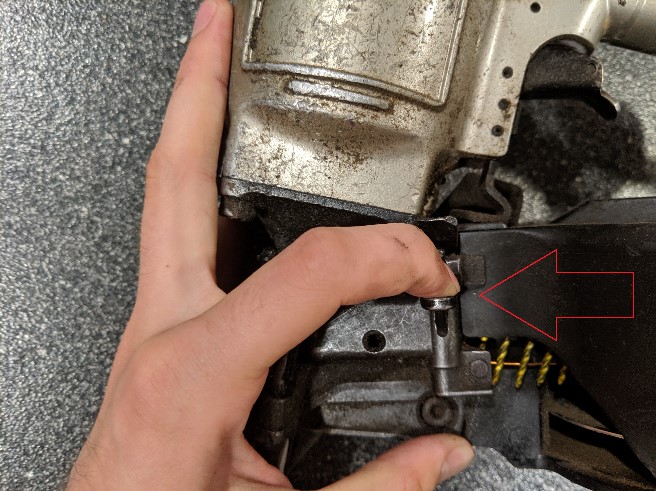
- Keeping your hand clear of the barrel, depress the latch on the feeder until it pops open. Figure 2
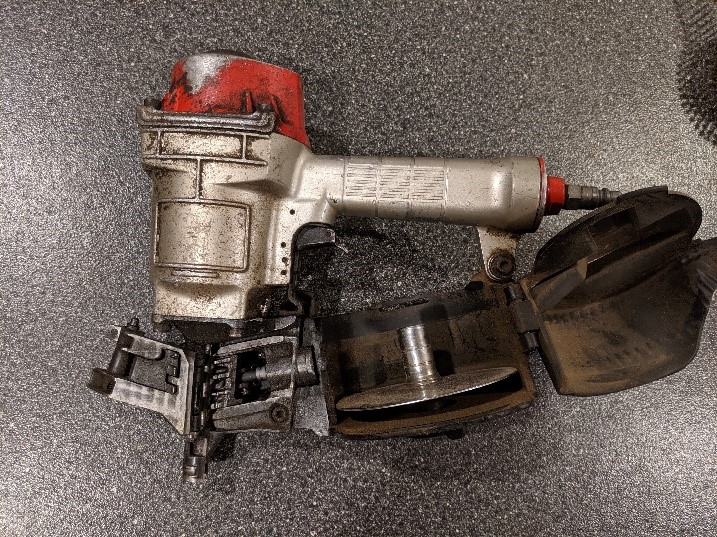
- Open the feeder and nail hopper. Figure 3 nails can now be added.
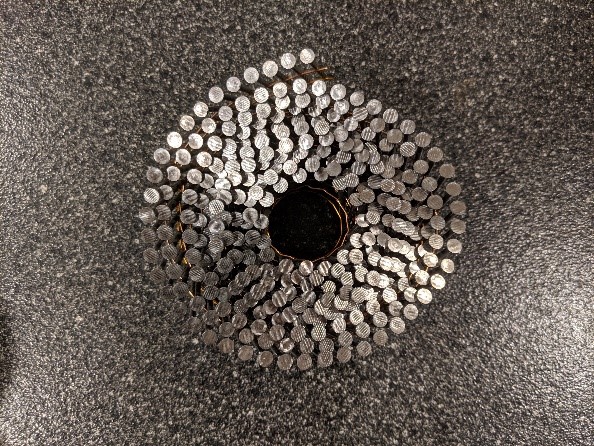
- Ensure you are using the correct size nail for the gun yor are using. Figure 4 These are the spools of nails used to reload your gun. Nails are different sizes depending on the sizr of gun being used.
- Place the spool of nails into the hopper with the nails feeding off the top of the spool and into teh feeder as shown in Figure 5.

- Feed the end of the spool into the feeder. The nanil heads will fit in a grooved track as depicted in Figure 6 and Figure 7.


- Close the nail hopper and re-latch the feeder.
Ensure that your hands stay clear of the nail gun’s barrel and the barrel is pointed away from you at all times while reloading nails.
Pneumatic Staple Gun
Pneumatic staple guns are used when building certain block pallets and specific pallet tops. They’re not as widely used as the nail guns but are typically used daily. Most of the time staple guns will by used in conjunction with nail guns. All table workers will be required to learn how to safely operate a pneumatic staple gun prior to beginning work.
First, familiarize yourself with the working parts of the nail gun. There are several moving parts that perform different functions as well as built in safety features that are designed to protect the user if used properly. The standard nail gun is depicted in Figure 8 below.

Steps to reload staples
- Pull down the spring-loaded release lever until it locks on the catch at the bottom of the staple track. Figure 9 and Figure 10.


- Load the staples onto the staple track rail as shown in Figure 11.

- Release the slider catch. This will push the staples into place. Be to hold the slider as you release the catch. Doing so will prevent the slider from violently pushing the staples into the feeder head which can cause harm to you and damage to the gun. Figure 12 and Figure 13.


Conclusion
Now that you have a basic overview of safety and the tools you will be using it’s time to do some hands on training. Your trainer will walk you through setting up your tools and give you further insight into safety protocol. You will also be instructed on proper production processes. This will give you a better understanding of how to efficiently produce the highest quality product.
If you have questions concerning safety or the production process, please feel free to ask. It’s important that you fully understand a process before you start a project.
Thank you for your time in thoroughly reading this orientation manual and welcome to the Precision Pallet family!